The other day I was walking through the second floor hallway at Garrett-Evangelical Theological Seminary, where I serve as Dean of the Chapel. I was surprised to see a class being taught in our largest classroom during the short break between our Spring semester and our first session of Summer intensive courses. “There are no classes now,” I thought to myself, “why on earth is there a class going on?” Well, it turned out that Northwestern University was using one of our rooms to hold a mathematics class. This immediately cracked me up. I imagined charging into the room and shouting, “Stop! No math here! You can’t do math at a theological seminary, for heaven’s sake, we believe that 1=3!”
Monday, May 28, 2012


Saturday, May 26, 2012
A brand-new Psalter!
Last February, a new Psalter, entitled Psalms for All Seasons: A Complete Psalter for Worship, was offered to the church by our brothers and sisters of the Christian Reformed Church and the Reformed Church in America. David Gambrell, the guest editor of the current issue of Liturgy, interviewed Martin Tel, the psalter’s co-editor about the process of its development, the criteria by which settings were selected, and the hopes that he holds for its use in the church.
Thursday, May 24, 2012
Pentecost: 27 May 2012
Comedian Ron White is a bit of an acquired taste, but one of the jokes he tells during his stand-up act always gets me. “There was a guy down in Florida who said that, at the age of 53 years old, he was in good enough physical condition to withstand the wind, rain and hail of a force-3 hurricane. Now, let me explain somethin' to ya. It isn't that the wind is blowin', it's what the wind is blowin'. If you get hit by a Volvo, it doesn't matter how many sit-ups you did that morning. If you have a "Yield" sign in your spleen, joggin' don't really come into play.”
Friday, May 18, 2012
A peek behind the curtain
As someone who loves music but has never had the skills to write it, I am always fascinated when composers give a glimpse of the multitude of factors that come into play when writing a piece of music.
Monday, May 14, 2012
Seventh Sunday of Easter, 20 May 2012
As promised, another two-for-one special! This post refers to Homily Service resources for the seventh Sunday of Easter, rather than Ascension of the Lord.
Ascension of the Lord: Thursday, May 17 or Sunday, May 20, 2012
Another two-for-one special!
One of the challenges facing those who try to woo the protestant branch of christianity into receiving the gifts of the liturgical year is that it is nearly impossible to get protestants to worship on a weekday. Bible study? Yes, of course! Prayer meeting? Why not? Boards and Committees? When else? Worship service for the Ascension of the Lord? Don’t be ridiculous! We’ll just hold that in abeyance until Sunday rolls around and do it then.
Friday, May 11, 2012
A Flock of Shepherds
In my last parish, the sanctuary boasted a gorgeous Tiffany glass shepherd window with a nice, clean anglo Jesus, cradling a nice clean lamb in his arms. I would guess that the same image is present in one form or another in the vast majority of churches throughout the world.
From high art to swapmeet kitsch, from icons to paintings to stained glass windows to the illustrations in Sunday School curricula, the shepherd image as a metaphor for the way in which God in Christ cares for humanity, has imprinted itself on the deepest level of the Christian imagination.
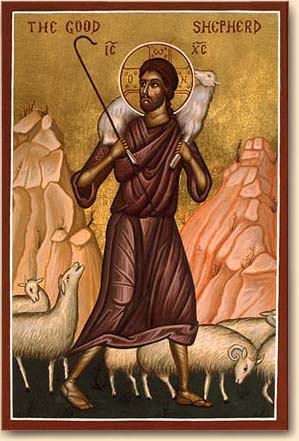


In the most recent issue of Liturgy, guest editor David Gambrell offers a sort of “Psalm 23 through the ages.” It is a fascinating glimpse at the various ways in which the church has read this most popular of psalms at various points since the invention of the printing press.
In order to offer a glimpse of the rich variety of psalm traditions through Christian history, the following pages present a roughly chronological sampling of translations and musical settings of the well-known ‘‘Shepherd Psalm,’’ Psalm 23. Following this psalm through the ages, one gets a sense of the musical trajectories that have shaped its use in liturgical song—from plain chant to metered settings, from unison to harmony, from responsorial arrangements to strophic hymns. This sampling also suggests a range of non- musical uses of the psalms—as a Bible lesson or devotional poetry, and in unison or responsive reading by the congregation. The texts represented here vary widely in their relation to the biblical text—from strict translations, to close paraphrases, to looser adaptations. Finally, watch the subtle variations in wording that have shaded the meaning of this psalm for generations of worshipers; pay special attention to what God does for the psalmist’s soul (convert, restore, reclaim, revive), the ‘‘valley of the shadow of death’’ (KJV), the language around anointing and the cup, and the final phrase of the psalm.
What is your own personal favorite iteration of the 23rd Psalm?
David Gambrell (2012): Following the Shepherd Psalm through the Ages, Liturgy, 27:3, 29.
David Gambrell is associate for worship in the Presbyterian Church (U.S.A.) Office of Theology and Worship and editor of Call to Worship: Liturgy, Music, Preaching, and the Arts.

All the cool blogs have pictures.
Monday, May 7, 2012
Sixth Sunday of Easter, Year B: 13 May 2012
The various gospel readings for the third, fourth, fifth and sixth Sundays of Easter are populated by an amazingly diverse group of metaphors by which we come to understand our relationship with God in Christ Jesus. Vine and branches; sheep and shepherd; sheep and gate; sender and receivers of the Spirit.
Sunday, May 6, 2012
Step by step
As a member of one of the denominations in which use of the lectionary including psalmody is encouraged but not required, it would be fascinating to me to see a statistical study of the current practice in those churches vis a vis psalmody.
Tuesday, May 1, 2012
Fifth Sunday of Easter: 6 May 2012
This week's readings from the Revised Common Lectionary are an embarrassment of riches: the vine and the branches (gospel); God is love (epistle); the Ethiopian eunuch (first lesson). Any preacher worth their salt could go on all day about any one of them.
Subscribe to:
Posts (Atom)